

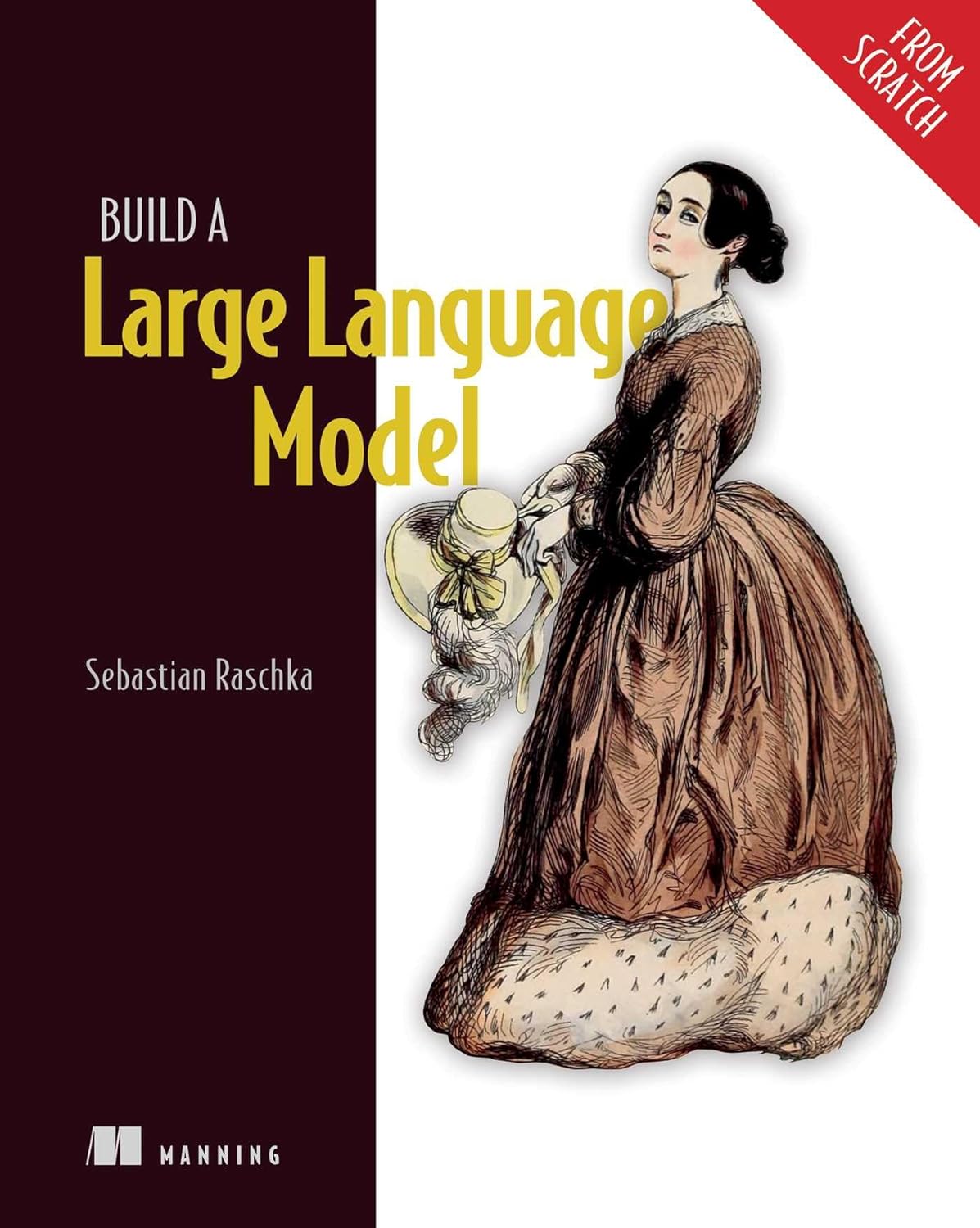
Build a Large Language Model
125,00 DH
Plongez dans les rouages internes de l'IA avec ce guide pratique pour construire votre propre modèle de langage à partir de zéro. Sebastian Raschka vous emmène dans un voyage étape par étape à travers le traitement de texte, les mécanismes d'attention et la formation de modèles sans recourir à des bibliothèques pré-construites. Apprenez à créer un modèle fonctionnel de style GPT qui s'exécute sur votre ordinateur portable en utilisant des exemples de code Python accessibles. Découvrez comment préparer les données d'entraînement, mettre en œuvre des techniques d'affinage et développer des modèles qui suivent les instructions. Le livre rend les concepts complexes de l'IA accessibles grâce à des explications claires et des schémas visuels. Parfait pour les développeurs prêts à aller au-delà de l'utilisation de modèles de boîte noire pour comprendre leurs fondements. Renforcez votre confiance dans le développement de l'IA grâce à des projets pratiques que vous pouvez réaliser avec des compétences Python intermédiaires. Passez du statut de consommateur d'IA à celui de créateur grâce à cette ressource complète. 🤖📚💡
Authors


Description
“Build a Large Language Model (From Scratch)” offers readers an unprecedented hands-on journey into the fascinating world of generative AI. Sebastian Raschka guides you through the complete process of constructing a functional large language model from the ground up, without relying on existing LLM libraries. This practical approach demystifies the complex inner workings of language models by breaking down each component into understandable segments, making advanced AI concepts accessible to those with intermediate Python skills and some machine learning knowledge.
The book takes you step by step through every critical stage of LLM development, beginning with text data preparation and attention mechanism implementation, progressing through building a GPT-style model, and culminating in pretraining and fine-tuning techniques. Raschka’s clear explanations, supported by helpful diagrams and practical code examples, ensure that readers not only understand what each component does but also why it’s essential to the overall architecture. One of the book’s most valuable aspects is that the models you build can run on a standard laptop, making advanced AI experimentation accessible without requiring specialized hardware.
Readers will discover how to prepare datasets suitable for LLM training, fine-tune models for specific tasks like text classification, and implement instruction-following capabilities using human feedback. The book also covers practical techniques such as loading pretrained weights and parameter-efficient fine-tuning with LoRA. What sets this work apart is its commitment to building understanding through creation – following physicist Richard P. Feynman’s principle that “I don’t understand anything I can’t build” – ensuring that readers develop a deep, intuitive grasp of how language models function rather than just using them as black boxes.
The comprehensive approach extends to supplementary materials that enhance the learning experience, including an introduction to PyTorch for those needing a refresher and detailed exercise solutions to reinforce concepts. The author’s expertise shines through in the carefully structured progression from basic components to complete systems, allowing readers to incrementally build their knowledge and confidence. This methodical approach has been praised by reviewers for making complex topics like self-attention mechanisms and transformer architecture not just understandable but implementable.
Sebastian Raschka’s teaching style combines academic rigor with practical engineering insights gained from his experience as a Staff Research Engineer at Lightning AI. The book has quickly established itself as a valuable resource in the rapidly evolving field of generative AI, with readers appreciating its balance of theoretical foundations and hands-on implementation. Whether you’re looking to deepen your understanding of existing language models or create your own customized solutions, this book provides the knowledge and tools to transform from an LLM user to an LLM builder.
Avis (0)

1984 Nineteen Eighty-Four

The Age of Reason

Good Golden Sun

You Are the Placebo


Shatter Me (Shatter Me Book 1)

God Emperor of Dune (Dune Saga book 4)



Dune Messiah (Dune Saga book 2)

12 Rules for Life: An Antidote to Chaos

SCIENCE AVEC CONSCIENCE



Avis
Il n’y a pas encore d’avis.